
Browse the profiles below to find out about the people associated with OSCIEF.
Abhijit Maiti, Post Doctoral Fellow 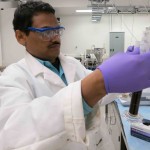
Characterization, pre-treatment, treatment… These are words to live by if you’re in the wastewater treatment business. A chemical engineering graduate from IIT Kharagpur, Abhijit came toCanadain February 2011. In a short time, he has been able to transfer his expertise in treating arsenic-contaminated groundwater inIndiato some of the most pressing problems in Canadian energy production. Arsenic contamination is a widespread problem in Southeast Asia and Abhijit helped to develop cost effective methods of using red-clay-based absorbent materials to filter out this poison. Once inCanada, he has used his knowledge in ultrafiltration techniques to contribute to the more effective use of water in the oil sands. The problems in heavy oil extraction, whether mining or SAGD, lend themselves to a recipe Abhijit learned inIndianamely characterization, pre-treatment, treatment.
His current work is focused on water quality management issues for the SAGD industry. He first spent time characterizing the SAGD process water to identify the organic and inorganic pollutants present. This characterization is essential in order to design the appropriate pre-treatment that effectively target these pollutants thus enhancing the final treatment of water. For example, identifying the chemical nature of the millions of types of dissolved organic matter (DOM) and then studying the interaction of DOMs fractions with silica could result in better separation techniques. While there are currently no such separation techniques to eliminate DOMs, the identification and elimination of problematic compounds can improve pre-treatment processes leading to reduced membrane fouling in the existing treatment of SAGD process water. Less fouling means that heavy oil extraction using SAGD is more energy efficient and cost effective.
When not hard at work, Abhijit can be found enjoying his family. He has two children, one of whom was born this year (2012) inCanada. Interestingly enough, Abhijit and his family have developed a taste for asparagus here inEdmonton, a vegetable unknown to him inIndia.
Sheng-Fei Zhang, PhD Student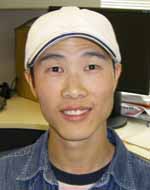
Sheng-Fei arrived in “chilly” September 2010 in Edmonton as an exchange student from the Chinese Academy of Science in Beijing. Unlike many programs in North America where PhD students complete course work, studying at the Chinese Academy is exclusively research-based and takes approximately five years. The time spent in Canada with Dr. Bhattacharjee has been a rewarding experience. When asked what happened over the past year that may not have happened back in China, Sheng-Fei focused on his contact with industry partners. The novelty of Dr. Bhattacharjee’s program is that students get to interact directly with leaders of private companies. As Sheng-Fei points out, this type of immediate feedback is invaluable highlighting both the utility and challenges of his research. In his direct discussions with companies, Sheng-Fei can see where his research efforts are best invested for the highest impact on present best practices in the industry.
Speaking of new experiences… Sheng-Fei visited Heritage Days in Edmonton this August (2011). Besides taking lots of pictures to share with family and friends on “RenRen.com,” the Chinese equivalent of Facebook, he was surprised by the shear number of different cultures represented at the event. This multicultural event was something new and unexpected for a person from Chinese culture that tends to be more homogenous. Specifically, Sheng-Fei took particular interest in the pavilion from Croatia where he was impressed by their food, clothing, and dance.
Md Abdullaha Al Mamun, MSc Student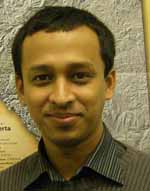
His name is Mamun but for a Canadian, this is not obvious… After a chat about how names are used in Bangladesh, I’m still confused and I’ll leave it at that. Let’s just say it’s a lot more complex than in western cultures.
Mamun started his studies at the UofA in September 2010. He has quickly completed five courses for his Master’s degree. Along with Dr. Bhattacharjee, he already has a soon-to-be-published paper on the topic of an electrokinetic model for membrane filtration. Although this paper is focused on computer simulations don’t let this fool you… All is not virtual for Mamun and he has interests in the “real” world. The grounding experience of working with his hands started in Bangladesh where he worked in BUET undergraduate labs using “scraps” to make things. He also worked at a fertilizer plant just before coming to Canada. Since this guy’s got one foot in the virtual world and the other in the real world, I asked him “What’s the difference?” Modestly, Mamun says obstacles in the simulations can easily be overcome using the right assumptions while the answer to obstacles in the real world at not obvious. His current experimental work is to continue progress in developing a microfluidic chip that can be used to test the stability of emulsions used in the energy industry.
Mamun’s arrival and survival in Edmonton have been made a lot easier because he came with two other friends from Bangladesh. Friends had warned him about the cold weather but that didn’t prevent him from thinking September was cold enough. The support from his friends is invaluable and the three of them conduct cooking blitzes on Saturdays to create tasty delights to enjoy during their weekly picnics.
Subhayan Guha Thakurta, MSc Student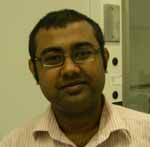
After graduating with a chemical engineering degree from Jadavpur University in India 2008 (Bachelor of Chemical Engineering), Subhayan immediately began work for GE Infrastructure (IGCC Team) on system integration and utility optimization. After GE, he worked with a consulting company on the engineering design of wastewater treatment plants. After this work experience, Subhayan came to two realizations. He decided that he wanted to work with water but he knew that he would need more training. After talking to his university mentor, he decided to apply with Dr. Bhattacharjee to learn more about water filtration and treatment. Despite some trepidation about studying within the confines of mechanical engineering, Subhayan has made the transition and integrated himself into Dr. Bhattacharjee’s research program. His area of study is focused on the blow-down water related to the SAGD process. The challenge is to improve the SAGD process in terms of water reuse. Current SAGD processes do, in fact, recycle much of the water used but this blow-down water is high in minerals and organic material making it unusable for steam production. This unusable blow-down water, a waste product of SAGD, is then injected down into geological formations. The goal is to reduce this quantity of blow-down water via newly developed treatments and filtration.
If you ask the affable Subhayan about his experience in Canada he proudly responds, “I’m a different man!” Apart from surviving a particularly long winter, Subhayan says that some western habits such as punctuality have become part of his way of life now. Not only that… Subhayan says he’s a happier person living in Edmonton, a city he describes, without reservation, as friendly. Could it be the traffic? Although Edmonton drivers are not usually cited for their congeniality, there is less of it when compared to Calcutta, one of the most populated cities on the planet. In fact, Subhayan has found a good group of friends in his apartment block with which to share experiences and laughs. His friends must enjoy another one of his hidden talents, cooking. Cooking, for Subhayan, is a science in which the principles of mixing, boiling points, and time management are applied to create dishes that satisfy the palette. Don’t you want to visit the mountains like most grad students? Subhayan is content and in no rush to go to Jasper or Banff since Edmonton is just fine with him.
Tathagata Chakraborty, MSc Student 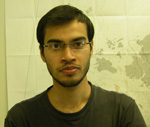
After almost 2 years in Canada, Tathagata Chakraborty is still trying to embrace Edmonton’s cold climate. “It’s a shocker,” admits the good-natured student. Apart from braving the cold, Tathagata “survives” the culinary step-change by hanging out at local Indian-style bistros such as Remedy and Karma. He’s also picked up a new habit in Canada… fruit juices. With some previous experience in industry, people might find it interesting that he points out that graduate studies can be quite hectic, i.e., it’s no picnic.
Tathagata’s research project is the natural evolution of work begun by Shahnawaz Molla. The research project is quaintly called “Surface fouling prevention using AC dielectrophoresis in a cross-flow mode.” While leaving out the gory details (you can take him out for coffee or chai to find out), this technology has implications for reducing the fouling of surfaces in industrial systems that use membrane filtration. The applications for this research are numerous and affect industries at the core of our society namely water and energy. Now that his experiments are complete, Tathagata hopes to finish up his thesis, graduate later this year, and begin an industrial internship related to fouling prevention.